Lady Thou Art So Near Gods Reckonings That Who Seeks Grace and Does
The Divine Comedy by Dante Alighieri · Digital Dante Edition with Commento Baroliniano · MMXIV-MMXX · Columbia University
Celestial Real Estate
Now that we take been "congiunti con la prima stella" (Par. two.30)and are in the sky of the moon, we are prepare to experience our first come across with a blessed soul. In this canto Dante volition meet Piccarda Donati. She is the sister of Forese Donati, the old friend from Florence with whom Dante had a nostalgic interaction on Purgatory's terrace of gluttony.
Forese died in 1296. For Piccarda we have less precise data. She was born in the eye of the thirteenth century and died at the end of the thirteenth century. Dante's intimacy with Forese is such that, when he meets Forese on the terrace of gluttony in Purgatory, he asks his friend nearly the whereabouts of his sis:
«Ma dimmi, se tu sai, dov'è Piccarda; dimmi s'io veggio da notar persona tra questa gente che sì mi riguarda.» «La mia sorella, che tra bella e buona non so qual fosse più, triunfa lieta ne 50'alto Olimpo già di sua corona.»(Purg.24.10-15)
"But tell me, if you can: where is Piccarda? And tell me if, amid those staring at me, I can encounter whatsoever person I should notation." "My sister—and I know not whether she was greater in her goodness or her beauty— on high Olympus is in triumph; she rejoices in her crown already."
Piccarda is "already in triumph in high Olympus" (Purg. 24.15) because, like her brother Forese, her death is very recent. Her position as already a blessed soul in Paradise betokens a very swift ascent upward the mountain of Purgatory.
Despite her swift ascent through Purgatory, Piccarda's location in Paradise seems (literally) inferior. There appear to be lower and higher heavens in Paradise, heavens that are therefore farther from and closer to God, and we see Piccarda in the everyman heaven (too the slowest heaven, considering the heavens motion more speedily every bit they become closer to God and to the Firmament). Information technology seems to be incontrovertibly the case that if i is in "la spera più tarda" (the slowest sphere [Par. three.51]), as Piccarda describes her home, one is in the least valuable celestial real estate.
Beatrice explains to the pilgrim that these souls are "relegated" here — a stiff option of verb that does cipher to minimize our developing sense of a lower guild of bliss — because of unfulfilled vows:
vere sustanze son ciò che tu vedi, qui rilegate per manco di voto. (Par. 3.29-xxx)
what you lot are seeing are true substances, placed here because their vows were not fulfilled.
The verb relegare is divers in the Hoepli Dizionario thus: "Obbligare qualcuno advertising allontanarsi dal luogo dove abitualmente vive per andare in united nations altro luogo lontano e sgradito; esiliare, confinare" (oblige someone to motility far away from their habitual place to a identify that is far off and unappealing; to exile).
We will acquire in Paradiso 9 that the starting time iii heavens are shadowed by the earth, and the consequence is that the souls of these heavens are characterized negatively: those who did non fulfill their vows (moon), those who lived with too much earthly ambition (Mercury), and those with too great an inclination toward eros (Venus).
Piccarda'southward language stresses her lowliness, prompting Dante-pilgrim to ask a naive but all-important question. It is an important question because it refocuses the paradox of the Ane and the Many that governs the Paradiso, as articulated in its opening terzina: the glory of the mover of all things penetrates a "Uni-verse" that is by definition One and even so that celebrity penetrates differentially, "in una parte più e meno altrove" (in one part more and in another less [Par. ane.3]).
So now Dante-pilgrim asks Piccarda whether she experiences unhappiness at being and so far from God, in the everyman of the heavens. Does she want a higher identify where she tin run into more than? And where she could be more "friends" with God? The childlike simplicity of the pilgrim's language only adds to the authorisation of the question, a question that brings to the surface all our unspoken business about unfairness standing on into the realm of justice itself.
Ma dimmi: voi che siete qui felici, disiderate voi più alto loco per più vedere e per più farvi amici? (Par. 3.64-66)
But tell me: though you lot're happy hither, do you desire a college place in society to see more than and to be still more close to Him?
Ambiguity well-nigh one's position in a hierarchy is a characteristic of human nature, and it is consequently a feature of discussions of Paradise. The poet of the Heart English language Pearl shows his business concern with rank in sky in his recurrent use of the adverbs "more" and "less," reminiscent of Dante's "più" and "meno": "Then the less, the more remuneration, / And ever alike, the less, the more" (10.5); "'Of more and less,' she answered directly, / 'In the Kingdom of God, no run a risk obtains'" (eleven.1; trans. Marie Borroff,Pearl [New York: Norton, 1977]).
Dante explicitly raises the issue of envy among the saints in Paradise in the his philosophical treatise Convivio, explaining that there is no envy because each soul reaches the limit of his personal beatitude: "E questa è la ragione per che li Santi not hanno tra loro invidia, però che ciascuno aggiugne lo fine del suo desiderio, lo quale desiderio è colla bontà della natura misurato" (This is the reason why the saints practise not envy one another, because each attains to the end of his want, which desire is proportionate to the nature of his goodness [Conv. 3.xv.10]). Modern imaginings of heaven, according to Carol Zaleski, take removed the problem: "For many people in our ain solar day, however, the plurality of heavens seems at terminal to accept lost its rationale; the very notion of ranking souls offends democratic instincts" (Otherworld Journeys, 60; see Coordinated Reading).
If nowadays the "very notion of ranking souls offends democratic instincts", it is worth noting that Dante stages his question to Piccarda precisely as a means of dramatizing the possibility of taking offense at souls being ranked from lowest to highest. The pilgrim's question gives Piccarda the opportunity to explain that heaven is a place where ane's desire is always satisfied, where want cannot possibly exceed the measure of what one has, and where it is always aligned with the will of the transcendent ability. In other words, the souls of Paradise are completely happy with the grace that is apportioned to them:
E 'n la sua volontade è nostra pace: ell'è quel mare al qual tutto si motility ciò ch'ella cria o che natura face. (Par. iii.85-87)
And in His will there is our peace: that ocean to which all beings move—the beings He creates or nature makes—such is His will.
Dante-poet scripts this dialogue every bit a model of ambiguity, in the etymological sense of allowing two different positions to materialize and to receive equal value. He is trying to dramatize the two prongs of his paradox as delineated in Paradiso one.ane-iii: the irreducible difference of the souls — the fact that they are "vere sustanze" (true substances) as Piccarda says in Paradiso iii.29 — can but be expressed via hierarchy, and still the concept of hierarchy is in apparent contradiction with the concepts of unity and similitude.
This contradiction is forcefully expressed in the narrator'southward summation of what he learned from Piccarda, where the crude Latinism "etsi" — "although" — pivots the syntax and the thought from unity to deviation:
Chiaro mi fu allor come ogne dove in cielo è paradiso, etsi la grazia del sommo ben d'un modo non vi piove. (Par. iii.88-xc)
Then it was articulate to me how every identify in Heaven is in Paradise, though grace does not rain equally from the Loftier Good.
In The Undivine Comedy I comment on the in a higher place terzina thus:
Everywhere in heaven is paradise, i.east., all heavenly locations are every bit good; still, at the same time, grace is not as distributed. This is a notion we can accept only if nosotros finish to recollect in terms of infinite; otherwise, we encounter the problem of all angelic real manor being every bit valued despite non receiving the same appurtenances and services. Moreover, if grace is not distributed d'un modo (a phrase that doubles in the Paradiso for igualmente), then it must perforce be distributed più e meno. And then nosotros return to the paradox of the Paradiso's commencement tercet, which Dante does not then much effort to resolve as hold upwardly for scrutiny, perusing it outset from one perspective and and so from another. Given that the problem of the i and the many is not i that Dante tin can, in fact, "resolve," we nonetheless may annotation that our poet seems more to revel in it than to desire to cover it over. (p 183)
The latter part of Paradiso 3 contains Piccarda'southward poignant story of having been violently kidnapped from the curtilage by the men of her brother Corso Donati. Her story is thus a story non of simple violence, but of Florentine political violence. Corso was the leader of the political faction of the Neri (the faction that exiled Dante); he wanted to requite his sister in dynastic wedlock in furtherance of his quest for alliance and political power. Piccarda also introduces the Empress Costanza, female parent of Frederick Two, who like her had joined the order of Santa Chiara merely was forced to exit for an even higher dynastic calling.
There is much in this story that echoes the story of Francesca, peculiarly in that both women experienced the typical destiny of upper-course women: they became pawns in dynastic marriages. Francesca committed adultery with her husband'southward brother, and her wedlock ended in uxoricide — as did the marriage of Pia dei Tolomei in Purgatorio 5. Nosotros note the common theme here, and sense Dante's interest in denouncing the injustice of dynastic marriage and the many ways in which the practice victimizes women. On this topic, meet my essay "Dante Alighieri" in Women and Gender in Medieval Europe: An Encyclopedia, cited in Coordinated Reading.
Piccarda refers to the "sugariness cloister" from which she was abducted by fierce men: "Uomini poi, a mal più ch'a bene usi, / fuor mi rapiron de la dolce chiostra" (And then men more than used to malice than to good took me — violently — from my sweet cloister [Par. 3.106-seven]). Her language is not a cultural anomaly; historians teach us that the curtilage was for many upper-grade women a desirable alternative to marriage.
Piccarda describes being forced — compelled confronting her will — to leave the cloister. The compulsion that she experienced will be a major theme of the side by side canto.
Coordinated Reading
Coordinated Reading: The Undivine One-act (Princeton: Princeton U. Printing, 1992), Affiliate 8, "Problems in Paradise: The Mimesis of Time and the Paradox of più e meno", pp. 172, 182-83; Carol Zaleski, Otherworld Journeys: Accounts of Virtually-Death Experiences in Medieval and Modern Times (New York: Oxford University Press, 1987; "Dante Alighieri", in Women and Gender in Medieval Europe: An Encyclopedia, ed. Margaret Schaus (Routledge, 2006).
Recommended Citation
Barolini, Teodolinda. "Paradiso three: Celestial Real Manor." Commento Baroliniano, Digital Dante. New York, NY: Columbia Academy Libraries, 2014. https://digitaldante.columbia.edu/dante/divine-comedy/paradiso/paradiso-three/
<paragraph number>
Commento Table of Contents
1Quel sol che pria d'amor mi scaldò 'fifty petto,
iidi bella verità yard'avea scoverto,
3provando eastward riprovando, il dolce aspetto;
ive io, per confessar corretto e certo
fiveme stesso, tanto quanto si convenne
6leva' il capo a proferer più erto;
7ma visïone apparve che ritenne
8a sé me tanto stretto, per vedersi,
9che di mia confession non mi sovvenne.
xQuali per vetri trasparenti due east tersi,
11o ver per acque nitide eastward tranquille,
12non sì profonde che i fondi sien persi,
thirteentornan d'i nostri visi le postille
14debili sì, che perla in bianca fronte
15non vien men forte a le nostre pupille;
16tali vid' io più facce a parlar pronte;
17per ch'io dentro a fifty'error contrario corsi
eighteena quel ch'accese amor tra 50'omo east 'fifty fonte.
19Sùbito sì com' io di lor m'accorsi,
xxquelle stimando specchiati sembianti,
21per veder di cui fosser, li occhi torsi;
22e nulla vidi, e ritorsili avanti
23dritti nel lume de la dolce guida,
24che, sorridendo, ardea ne li occhi santi.
25«Non ti maravigliar perch' io sorrida»,
26mi disse, «appresso il tuo püeril coto,
27poi sopra 'l vero ancor lo piè non fida,
28ma te rivolve, come up suole, a vòto:
29vere sustanze son ciò che tu vedi,
xxxqui rilegate per manco di voto.
31Però parla con esse e odi e credi;
32ché la verace luce che le appaga
33da sé non lascia lor torcer li piedi».
34East io a l'ombra che parea più vaga
35di ragionar, drizza'mi, e cominciai,
36quasi com' uom cui troppa voglia smaga:
37«O ben creato spirito, che a' rai
38di vita etterna la dolcezza senti
39che, non gustata, non due south'intende mai,
twoscoregrazïoso mi fia se mi contenti
41del nome tuo east de la vostra sorte».
42Ond' ella, pronta e con occhi ridenti:
43«La nostra carità non serra porte
44a giusta voglia, se non come quella
45che vuol simile a sé tutta sua corte.
46I' fui nel mondo vergine sorella;
47due east se la mente tua ben sé riguarda,
48non mi ti celerà l'esser più bella,
49ma riconoscerai ch'i' son Piccarda,
50che, posta qui con questi altri beati,
51beata sono in la spera più tarda.
52Li nostri affetti, che solo infiammati
53son nel piacer de lo Spirito Santo,
54letizian del suo ordine formati.
55E questa sorte che par giù cotanto,
56però northward'è data, perché fuor negletti
57li nostri voti, e vòti in alcun canto».
58Ond' io a lei: «Ne' mirabili aspetti
59vostri risplende non so che divino
60che vi trasmuta da' primi concetti:
61però non fui a rimembrar festino;
62ma or thousand'aiuta ciò che tu mi dici,
63sì che raffigurar yard'è più latino.
64Ma dimmi: voi che siete qui felici,
65disiderate voi più alto loco
66per più vedere e per più farvi amici?».
67Con quelle altr' ombre pria sorrise united nations poco;
68da indi mi rispuose tanto lieta,
69ch'arder parea d'amor nel primo foco:
lxx«Frate, la nostra volontà quïeta
71virtù di carità, che fa volerne
72sol quel ch'avemo, eastward d'altro non ci asseta.
73Se disïassimo esser più superne,
74foran discordi li nostri disiri
75dal voler di colui che qui ne cerne;
76che vedrai not capere in questi giri,
77s'essere in carità è qui necesse,
78due east se la sua natura ben rimiri.
79Anzi è formale advertizing esto beato esse
fourscoretenersi dentro a la divina voglia,
81per ch'una fansi nostre voglie stesse;
82sì che, come noi sem di soglia in soglia
83per questo regno, a tutto il regno piace
84com' a lo re che 'northward suo voler ne 'nvoglia.
85Due east 'n la sua volontade è nostra step:
86ell' è quel mare al qual tutto si movement
87ciò ch'ella crïa o che natura face».
88Chiaro mi fu allor come ogne dove
89in cielo è paradiso, etsi la grazia
ninetydel sommo ben d'united nations modo non vi piove.
91Ma sì com' elli avvien, due south'un cibo sazia
92east d'un altro rimane ancor la gola,
93che quel si chere e di quel si ringrazia,
94così fec' io con atto eastward con parola,
95per apprender da lei qual fu la tela
96onde non trasse infino a co la spuola.
97«Perfetta vita e alto merto inciela
98donna più sù», mi disse, «a la cui norma
99nel vostro mondo giù si veste e vela,
100perché fino al morir si vegghi e dorma
101con quello sposo ch'ogne voto accetta
102che caritate a suo piacer conforma.
103Dal mondo, per seguirla, giovinetta
104fuggi'mi, e nel suo abito mi chiusi
105e promisi la via de la sua setta.
106Uomini poi, a mal più ch'a bene usi,
107fuor mi rapiron de la dolce chiostra:
108Iddio si sa qual poi mia vita fusi.
109E quest' altro splendor che ti si mostra
110da la mia destra parte e che s'accende
111di tutto il lume de la spera nostra,
112ciò ch'io dico di me, di sé intende;
113sorella fu, due east così le fu tolta
114di capo l'ombra de le sacre bende.
115Ma poi che pur al mondo fu rivolta
116contra suo grado due east contra buona usanza,
117non fu dal vel del cor già mai disciolta.
118Quest' è la luce de la gran Costanza
119che del secondo vento di Soave
120generò 'l terzo east l'ultima possanza».
121Così parlommi, east poi cominciò 'Ave,
122 Maria' cantando, e cantando vanio
123come per acqua cupa cosa grave.
124La vista mia, che tanto lei seguio
125quanto possibil fu, poi che la perse,
126volsesi al segno di maggior disio,
127e a Beatrice tutta si antipodal;
128ma quella folgorò nel mïo sguardo
129sì che da prima il viso not sofferse;
130east ciò mi fece a dimandar più tardo.
That sun which first had warmed my breast with love
had now revealed to me, confuting, proving,
the gentle confront of truth, its loveliness;
and I, in order to declare myself
corrected and convinced, lifted my caput
every bit high every bit my confessional required.
But a new vision showed itself to me;
the grip in which information technology held me was so fast
that I did not recall to confess.
Just as, returning through transparent, clean
drinking glass, or through waters calm and crystalline
(so shallow that they scarcely can reverberate),
the mirrored image of our faces meets
our pupils with no greater force than that
a pearl has when displayed on a white forehead—
and so faint, the many faces I saw keen
to speak; thus, my mistake was contrary
to that which led the human to love the fountain.
As soon as I had noticed them, thinking
that what I saw were merely mirrorings,
I turned around to meet who they might be;
and I saw nothing; and I allow my sight
turn back to meet the light of my love guide,
who, as she smiled, glowed in her holy optics.
"There is no need to wonder if I grin,"
she said, "because yous reason like a child;
your steps do non yet rest upon the truth;
your listen misguides you into emptiness:
what you are seeing are true substances,
placed here because their vows were non fulfilled.
Thus, speak and heed; trust what they will say:
the true light in which they notice their peace
volition not allow their steps to turn astray."
And so I turned to the shade that seemed most anxious
to speak, and I began as would a homo
bewildered by desire too intense:
"O spirit born to goodness, you who feel,
beneath the rays of the eternal life,
that sweetness which cannot be known unless
information technology is experienced, information technology would be gracious
of you to permit me know your name and fate."
At this, unhesitant, with grin eyes:
"Our charity will never lock its gates
confronting merely will; our dearest is similar the Dear
that would have all Its court exist like Itself.
Within the earth I was a nun, a virgin;
and if your mind attends and recollects,
my greater beauty here will not muffle me,
and yous will recognize me as Piccarda,
who, placed hither with the other blessed ones,
am blessed within the slowest of the spheres.
Our sentiments, which simply serve the flame
that is the pleasance of the Holy Ghost,
delight in their conforming to His social club.
And we are to be found within a sphere
this depression, because we have neglected vows,
so that in some respect nosotros were deficient."
And I to her: "Inside your wonderful
semblance there is something divine that glows,
transforming the appearance yous once showed:
therefore, my recognizing you was slow;
merely what you now accept told me is of assist;
I tin identify you lot much more clearly.
Simply tell me: though you're happy here, practice you
want a college place in gild to
run into more and to be still more close to Him?"
Together with her fellow shades she smiled
at first; and then she replied to me with such
gladness, like one who burns with dearest's showtime flame:
"Brother, the power of dearest appeases our
will so—we only long for what nosotros have;
nosotros do not thirst for greater blessedness.
Should we desire a college sphere than ours,
then our desires would be discordant with
the will of Him who has assigned united states of america here,
simply you'll see no such discord in these spheres;
to live in love is—here—necessity,
if you remember on love's nature advisedly.
The essence of this blessed life consists
in keeping to the boundaries of God'due south will,
through which our wills get i single volition;
so that, as we are ranged from step to stride
throughout this kingdom, all this kingdom wills
that which volition please the King whose will is dominion.
And in His will at that place is our peace: that sea
to which all beings move—the beings He
creates or nature makes—such is His will."
Then information technology was articulate to me how every place
in Heaven is in Paradise, though grace
does not rain as from the High Good.
Just simply equally, when our hunger has been sated
with i food, we still long to taste the other—
while thankful for the first, we crave the latter—
so was I in my words and in my gestures,
asking to learn from her what was the web
of which her shuttle had not reached the stop.
"A perfect life," she said, "and her high merit
enheaven, up higher up, a woman whose
dominion governs those who, in your world, would habiliment
nuns' wearing apparel and veil, so that, until their expiry,
they wake and sleep with that Spouse who accepts
all vows that beloved conforms unto His pleasure.
Still young, I fled the world to follow her;
and, in her order's habit, I enclosed
myself and promised my life to her rule.
Then men more than used to malice than to good
took me—violently—from my sugariness cloister:
God knows what, afterward that, my life became.
This other radiance that shows itself
to yous at my correct hand, a brightness kindled
by all the light that fills our heaven—she
has understood what I accept said: she was
a sister, and from her caput, likewise, by force,
the shadow of the sacred veil was taken.
Simply though she had been turned back to the world
against her will, against all honest practice,
the veil upon her middle was never loosed.
This is the splendor of the not bad Costanza,
who from the Swabians' second gust engendered
the one who was their 3rd and final power."
This said, she and so began to sing "Ave
Maria" and, while singing, vanished every bit
a weighty thing will vanish in deep water.
My sight, which followed her equally long as information technology
was able to, once she was out of view,
returned to where its greater longing lay,
and it was wholly bent on Beatrice;
but she then struck my optics with so much brightness
that I, at first, could non withstand her force;
and that made me delay my questioning.
THAT Sun, which erst with love my bosom warmed,
Of beauteous truth had unto me discovered,
By proving and reproving, the sweet aspect.
And, that I might confess myself convinced
And confident, and then far as was conforming,
I lifted more erect my head to speak.
But there appeared a vision, which withdrew me
So shut to it, in order to exist seen,
That my confession I remembered not.
Such every bit through polished and transparent glass,
Or waters crystalline and undisturbed,
Simply not then deep as that their bed be lost,
Come up back again the outlines of our faces
So feeble, that a pearl on brow white
Comes non less chop-chop unto our eyes;
Such saw I many faces prompt to speak,
Then that I ran in error opposite
To that which kindled love 'twixt homo and fountain.
As soon as I became enlightened of them,
Esteeming them as mirrored semblances,
To see of whom they were, mine eyes I turned,
And naught saw, and once more than turned them forrard
Direct into the light of my sweet Guide,
Who smiling kindled in her holy eyes.
"Marvel thou not,"she said to me,"because
I grin at this thy puerile conceit,
Since on the truth it trusts not however its foot,
Merely turns thee, equally 'tis wont, on emptiness.
Truthful substances are these which k beholdest,
Here relegate for breaking of some vow.
Therefore speak with them, listen and believe;
For the true light, which giveth peace to them,
Permits them not to turn from information technology their feet."
And I unto the shade that seemed almost wishful
To speak directed me, and I began,
As one whom also great eagerness bewilders:
"O well—created spirit, who in the rays
Of life eternal dost the sugariness gustation
Which being untasted ne'er is comprehended.
Grateful 'twill be to me, if thou content me
Both with thy name and with your destiny."
Whereat she promptly and with laughing eyes:
"Our charity doth never close the doors
Confronting a merely desire, except every bit one
Who wills that all her court exist like herself.
I was a virgin sister in the world;
And if thy mind doth contemplate me well,
The being more off-white will non conceal me from thee,
Simply thousand shalt recognise I am Piccarda,
Who, stationed here amongst these other blessed,
Myself am blessed in the slowest sphere.
All our angel, that alone inflamed
Are in the pleasance of the Holy Ghost,
Rejoice at being of his guild formed;
And this allotment, which appears then low,
Therefore is given u.s.a., because our vows
Have been neglected and in some part void."
Whence I to her: "In your miraculous aspects
There shines I know not what of the divine,
Which doth transform you from our first conceptions.
Therefore I was not swift in my remembrance;
But what grand tellest me now aids me so,
That the refiguring is easier to me.
But tell me, ye who in this place are happy,
Are you desirous of a college place,
To run across more or to make yourselves more friends ?"
First with those other shades she smiled a little;
Thereafter answered me so full of gladness,
She seemed to fire in the starting time fire of dear:
"Brother, our volition is quieted by virtue
Of charity, that makes us wish alone
For what nosotros accept, nor gives us thirst for more.
If to exist more than exalted we aspired,
Discordant would our aspirations be
Unto the will of Him who hither secludes u.s.a.;
Which k shalt come across finds no place in these circles,
If being in clemency is needful here,
And if thou lookest well into its nature;
Nay, 'tis essential to this blest beingness
To keep itself within the volition divine,
Whereby our very wishes are made one;
So that, equally we are station to a higher place station
Throughout this realm, to all the realm 'tis pleasing,
As to the King, who makes his volition our will.
And his will is our peace; this is the sea
To which is moving onward whatsoever
It doth create, and all that nature makes."
And so it was articulate to me how everywhere
In heaven is Paradise, although the grace
Of adept supreme there rain not in one measure
Only equally it comes to pass, if one food sates,
And for another nevertheless remains the longing,
We ask for this, and that reject with thanks,
E'en thus did I; with gesture and with give-and-take,
To acquire from her what was the spider web wherein
She did not ply the shuttle to the end.
"A perfect life and merit high in—heaven
A lady o'er usa," said she, "by whose rule
Downwardly in your earth they vest and veil themselves,
That until death they may both watch and slumber
Beside that Spouse who every vow accepts
Which charity conformeth to his pleasance.
To follow her, in girlhood from the globe
I fled, and in her habit shut myself,
And pledged me to the pathway of her sect.
So men accepted unto evil more than
Than unto proficient, from the sweet cloister tore me;
God knows what subsequently my life became.
This other splendour, which to thee reveals
Itself on my right side, and is enkindled
With all the illumination of our sphere,
What of myself I say applies to her;
A nun was she, and likewise from her head
Was ta'en the shadow of the sacred wimple.
Merely when she too was to the world returned
Against her wishes and against good usage,
Of the heart's veil she never was divested.
Of great Costanza this is the brightness,
Who from the second air current of Suabia
Brought forth the third and latest puissance."
Thus unto me she spake, and and so began
_"Ave Maria"_ singing, and in singing
Vanished, every bit through deep water something heavy.
My sight, that followed her equally long a time
Equally it was possible, when it had lost her
Turned circular unto the mark of more desire,
And wholly unto Beatrice reverted;
But she such lightnings flashed into mine eyes,
That at the offset my sight endured information technology non;
And this in questioning more backward fabricated me.
That sun which kickoff had warmed my chest with love
had now revealed to me, confuting, proving,
the gentle face of truth, its loveliness;
and I, in order to declare myself
corrected and convinced, lifted my head
as loftier as my confessional required.
Only a new vision showed itself to me;
the grip in which information technology held me was so fast
that I did not recollect to confess.
Merely as, returning through transparent, make clean
glass, or through waters calm and crystalline
(so shallow that they scarcely can reflect),
the mirrored image of our faces meets
our pupils with no greater force than that
a pearl has when displayed on a white forehead—
and then faint, the many faces I saw keen
to speak; thus, my fault was reverse
to that which led the man to love the fountain.
Equally soon as I had noticed them, thinking
that what I saw were just mirrorings,
I turned around to encounter who they might be;
and I saw nothing; and I let my sight
turn back to see the light of my dear guide,
who, as she smiled, glowed in her holy eyes.
"There is no need to wonder if I smile,"
she said, "considering y'all reason similar a child;
your steps do not yet remainder upon the truth;
your listen misguides you into emptiness:
what you are seeing are true substances,
placed here because their vows were not fulfilled.
Thus, speak and mind; trust what they will say:
the truthful light in which they observe their peace
will non allow their steps to plough astray."
Then I turned to the shade that seemed most broken-hearted
to speak, and I began equally would a man
bewildered by desire besides intense:
"O spirit built-in to goodness, you who feel,
beneath the rays of the eternal life,
that sweet which cannot be known unless
it is experienced, it would be gracious
of you to allow me know your proper name and fate."
At this, unhesitant, with smile eyes:
"Our charity will never lock its gates
confronting just will; our dear is similar the Love
that would accept all Its courtroom be like Itself.
Within the world I was a nun, a virgin;
and if your heed attends and recollects,
my greater beauty here will not conceal me,
and yous will recognize me equally Piccarda,
who, placed here with the other blessed ones,
am blest within the slowest of the spheres.
Our sentiments, which simply serve the flame
that is the pleasance of the Holy Ghost,
please in their befitting to His society.
And we are to exist found within a sphere
this low, because nosotros accept neglected vows,
so that in some respect we were deficient."
And I to her: "Within your wonderful
semblance there is something divine that glows,
transforming the advent you once showed:
therefore, my recognizing y'all was slow;
but what y'all now have told me is of help;
I can identify yous much more clearly.
But tell me: though you're happy here, do you
desire a higher place in club to
see more and to be all the same more than close to Him?"
Together with her beau shades she smiled
at outset; and so she replied to me with such
gladness, like one who burns with love's starting time flame:
"Brother, the ability of honey appeases our
will so—nosotros only long for what we accept;
nosotros do non thirst for greater blessedness.
Should nosotros desire a higher sphere than ours,
then our desires would be discordant with
the will of Him who has assigned us here,
but you'll see no such discord in these spheres;
to live in dearest is—here—necessity,
if you lot recollect on beloved's nature carefully.
The essence of this blessed life consists
in keeping to the boundaries of God'southward will,
through which our wills become 1 single will;
so that, every bit we are ranged from stride to stride
throughout this kingdom, all this kingdom wills
that which will please the Male monarch whose volition is dominion.
And in His will at that place is our peace: that sea
to which all beings move—the beings He
creates or nature makes—such is His will."
Then it was articulate to me how every place
in Heaven is in Paradise, though grace
does not rain equally from the High Practiced.
But just as, when our hunger has been sated
with one food, nosotros still long to sense of taste the other—
while thankful for the first, nosotros crave the latter—
so was I in my words and in my gestures,
request to learn from her what was the web
of which her shuttle had not reached the end.
"A perfect life," she said, "and her high merit
enheaven, upwardly above, a woman whose
dominion governs those who, in your world, would article of clothing
nuns' dress and veil, so that, until their expiry,
they wake and sleep with that Spouse who accepts
all vows that dearest conforms unto His pleasure.
Still young, I fled the world to follow her;
and, in her order'southward habit, I enclosed
myself and promised my life to her rule.
Then men more used to malice than to proficient
took me—violently—from my sweetness cloister:
God knows what, after that, my life became.
This other radiance that shows itself
to yous at my right mitt, a brightness kindled
by all the calorie-free that fills our heaven—she
has understood what I have said: she was
a sister, and from her head, likewise, past forcefulness,
the shadow of the sacred veil was taken.
But though she had been turned back to the world
against her volition, against all honest practise,
the veil upon her heart was never loosed.
This is the splendor of the great Costanza,
who from the Swabians' second gust engendered
the one who was their 3rd and concluding ability."
This said, she and then began to sing "Ave
Maria" and, while singing, vanished as
a weighty affair will vanish in deep water.
My sight, which followed her as long every bit information technology
was able to, once she was out of view,
returned to where its greater longing lay,
and information technology was wholly bent on Beatrice;
merely she then struck my optics with so much brightness
that I, at first, could non withstand her strength;
and that made me delay my questioning.
THAT Lord's day, which erst with love my bosom warmed,
Of admirable truth had unto me discovered,
By proving and reproving, the sweet aspect.
And, that I might confess myself convinced
And confident, so far as was befitting,
I lifted more erect my head to speak.
But there appeared a vision, which withdrew me
So close to information technology, in order to be seen,
That my confession I remembered not.
Such as through polished and transparent glass,
Or waters crystalline and undisturbed,
But not and so deep as that their bed be lost,
Come back over again the outlines of our faces
So feeble, that a pearl on forehead white
Comes not less speedily unto our optics;
Such saw I many faces prompt to speak,
So that I ran in mistake opposite
To that which kindled love 'twixt human and fountain.
Equally soon as I became enlightened of them,
Esteeming them as mirrored semblances,
To see of whom they were, mine eyes I turned,
And nothing saw, and in one case more than turned them forward
Straight into the light of my sweet Guide,
Who grin kindled in her holy optics.
"Marvel chiliad not,"she said to me,"because
I grin at this thy puerile conceit,
Since on the truth it trusts not yet its human foot,
But turns thee, as 'tis wont, on emptiness.
Truthful substances are these which m beholdest,
Here relegate for breaking of some vow.
Therefore speak with them, listen and believe;
For the true light, which giveth peace to them,
Permits them not to turn from it their anxiety."
And I unto the shade that seemed nigh wishful
To speak directed me, and I began,
Every bit ane whom likewise great eagerness bewilders:
"O well—created spirit, who in the rays
Of life eternal dost the sugariness taste
Which being untasted ne'er is comprehended.
Grateful 'twill be to me, if thou content me
Both with thy proper name and with your destiny."
Whereat she promptly and with laughing eyes:
"Our clemency doth never shut the doors
Against a just desire, except as one
Who wills that all her court be like herself.
I was a virgin sister in the world;
And if thy mind doth contemplate me well,
The beingness more fair will not conceal me from thee,
Merely thou shalt recognise I am Piccarda,
Who, stationed here amidst these other blessed,
Myself am blessed in the slowest sphere.
All our angel, that alone inflamed
Are in the pleasure of the Holy Ghost,
Rejoice at being of his order formed;
And this allocation, which appears so depression,
Therefore is given us, because our vows
Accept been neglected and in some part void."
Whence I to her: "In your miraculous aspects
There shines I know not what of the divine,
Which doth transform you lot from our first conceptions.
Therefore I was not swift in my remembrance;
But what yard tellest me at present aids me then,
That the refiguring is easier to me.
Merely tell me, ye who in this place are happy,
Are y'all desirous of a higher place,
To see more or to make yourselves more friends ?"
First with those other shades she smiled a petty;
Thereafter answered me so full of gladness,
She seemed to burn in the commencement burn of beloved:
"Brother, our will is quieted past virtue
Of charity, that makes united states wish alone
For what we take, nor gives the states thirst for more than.
If to be more exalted we aspired,
Discordant would our aspirations be
Unto the will of Him who here secludes us;
Which thou shalt see finds no place in these circles,
If being in charity is needful here,
And if yard lookest well into its nature;
Nay, 'tis essential to this blest existence
To keep itself inside the will divine,
Whereby our very wishes are fabricated one;
So that, as we are station in a higher place station
Throughout this realm, to all the realm 'tis pleasing,
As to the King, who makes his volition our volition.
And his will is our peace; this is the ocean
To which is moving onward whatsoever
It doth create, and all that nature makes."
Then it was clear to me how everywhere
In heaven is Paradise, although the grace
Of expert supreme there pelting not in one measure
Only every bit it comes to laissez passer, if one food sates,
And for another still remains the longing,
We ask for this, and that pass up with thanks,
E'en thus did I; with gesture and with word,
To learn from her what was the web wherein
She did not ply the shuttle to the end.
"A perfect life and merit high in—heaven
A lady o'er us," said she, "past whose dominion
Downwardly in your world they belong and veil themselves,
That until decease they may both watch and sleep
Abreast that Spouse who every vow accepts
Which clemency conformeth to his pleasure.
To follow her, in girlhood from the world
I fled, and in her habit shut myself,
And pledged me to the pathway of her sect.
And then men accustomed unto evil more than
Than unto expert, from the sweet cloister tore me;
God knows what afterward my life became.
This other splendour, which to thee reveals
Itself on my right side, and is enkindled
With all the illumination of our sphere,
What of myself I say applies to her;
A nun was she, and also from her head
Was ta'en the shadow of the sacred wimple.
But when she too was to the world returned
Against her wishes and confronting good usage,
Of the center's veil she never was divested.
Of great Costanza this is the effulgence,
Who from the second wind of Suabia
Brought along the third and latest puissance."
Thus unto me she spake, and then began
_"Ave Maria"_ singing, and in singing
Vanished, every bit through deep h2o something heavy.
My sight, that followed her equally long a time
As it was possible, when it had lost her
Turned round unto the mark of more than desire,
And wholly unto Beatrice reverted;
But she such lightnings flashed into mine eyes,
That at the first my sight endured it non;
And this in questioning more astern fabricated me.
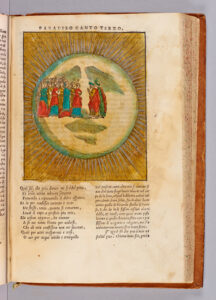
Dante and Beatrice meet Piccarda, the sister of Forese Donati, who explains that all the souls in Paradise are happy to presume their rightful places in God's order. She also introduces them to Empress Constance of Sicily.
Related video
View all lecture videos on the Dante Form page .
Source: https://digitaldante.columbia.edu/dante/divine-comedy/paradiso/paradiso-3/
0 Response to "Lady Thou Art So Near Gods Reckonings That Who Seeks Grace and Does"
Post a Comment